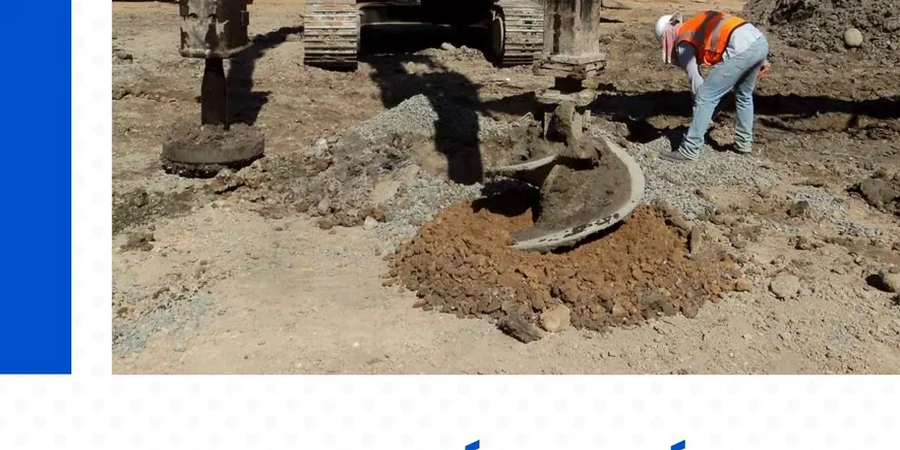
Ground improvement in Houston encompasses a suite of geotechnical techniques designed to enhance the engineering properties of soil, making it suitable for construction. Houston's rapid urban expansion, coupled with its challenging subsurface conditions, makes these methods essential for safe and durable infrastructure. From expansive clays to loose sands, the natural ground often lacks the strength and stability required for heavy structures or pavements. This category covers everything from deep vibratory methods to rigid inclusions, all aimed at increasing bearing capacity, reducing settlement, and mitigating liquefaction risk. For engineers and developers, understanding these solutions is not just a technical requirement but a fundamental step in risk management and project feasibility.
Houston's geology is dominated by the Beaumont and Lissie Formations, which consist of Pleistocene-age clays, silts, and sands deposited by ancient river systems. The city's flat topography belies a complex stratigraphy of overconsolidated clays near the surface, underlain by loose, saturated sands. This profile creates two primary geohazards: significant shrink-swell potential in the clay layers and a susceptibility to liquefaction in the sandy strata during seismic events or vibrations. The Gulf Coast's high water table further complicates construction, as excavations often encounter groundwater, demanding improvement techniques that can be executed in saturated conditions without destabilizing the soil matrix.
Local regulations and national standards strictly govern ground modification projects. The City of Houston follows the International Building Code (IBC), which references industry standards such as those from the American Society of Civil Engineers (ASCE) and the Deep Foundations Institute (DFI). Specifically, ASCE 7 provides minimum design loads, while specifications like ASTM D4718 guide compaction testing. For liquefaction assessment, practitioners rely on methodologies from the National Center for Earthquake Engineering Research (NCEER). These codes ensure that any ground improvement design meets rigorous performance criteria for settlement control and bearing capacity, protecting public safety and property in a region where hurricane-induced flooding and soil instability are constant threats.
The types of projects that demand ground improvement in Houston are diverse. Heavy commercial developments, such as high-rise towers in the Galleria area or distribution warehouses near the Port of Houston, often require advanced foundation support to handle structural loads on soft soils. Infrastructure works, including highway expansions on I-45 and flood control levees, use techniques like stone column design to reinforce embankments and prevent erosion. Industrial facilities with large storage tanks, particularly in the petrochemical corridor, benefit from vibrocompaction design to densify loose sands and eliminate the risk of differential settlement. Even residential subdivisions in areas like Katy or The Woodlands increasingly incorporate ground improvement to combat the destructive effects of expansive clays on home foundations.
Ground improvement refers to the modification of in-situ soil properties to enhance strength, reduce compressibility, or control permeability. In Houston, it becomes necessary when native Beaumont clays exhibit high shrink-swell potential or when loose, saturated sands pose a liquefaction risk. Any project requiring stable foundations on these challenging soils—from commercial buildings to pavements—can benefit from these techniques to avoid excessive settlement and structural damage.
Selection depends on a thorough geotechnical investigation that identifies soil stratigraphy, groundwater conditions, and project loads. For loose granular soils with a high water table, vibrocompaction may be ideal. When reinforcing soft cohesive clays, stone columns are often preferred. The choice balances performance requirements with constructability, guided by ASCE standards and local experience to ensure the method effectively mitigates the specific geohazard present.
Yes, projects must comply with numerous ASTM standards referenced by the IBC. Key ones include ASTM D1586 for standard penetration testing to evaluate soil density, ASTM D4718 for correction of compaction test results, and ASTM D698 for laboratory compaction characteristics. For stone columns, ASTM D6913 covers particle-size analysis of the backfill material. Adherence ensures that design parameters and quality control testing meet accepted engineering practice.
While no technique completely eliminates the movement of expansive clays, ground improvement can significantly mitigate its effects. Methods like moisture conditioning or lime stabilization alter the clay's mineralogy to reduce its swell potential. Alternatively, stone columns can create a composite ground mass that distributes loads and limits differential heave. Properly designed, these solutions protect foundations from the cyclical shrinkage and swelling that commonly damages Houston homes.